
Views: 0 Author: Site Editor Publish Time: 2026-05-18 Origin: Site
3D printing is a valuable manufacturing process that helps turn digital designs into physical parts. For OEM engineers and product teams, it is heavily utilized for rapid prototypes, design testing, custom fixtures, and low-volume trial parts before moving into mass production.
At Feigeer Tech, 3D printing is rarely a standalone solution; it is often used alongside CNC machining. A project typically begins with a 3D-printed sample for quick design validation, then transitions to precision CNC machining once the final material, tolerances, and production requirements are locked in.
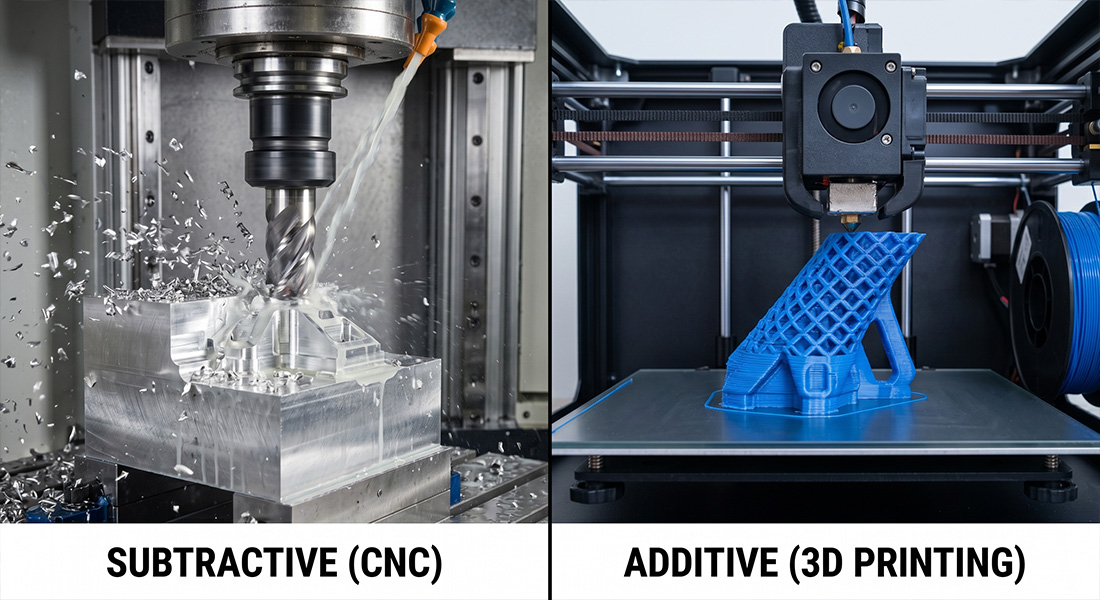
Also known as additive manufacturing, 3D printing creates parts by adding material layer by layer directly from a 3D CAD model. This contrasts directly with subtractive methods like CNC machining (which removes material from a solid block).
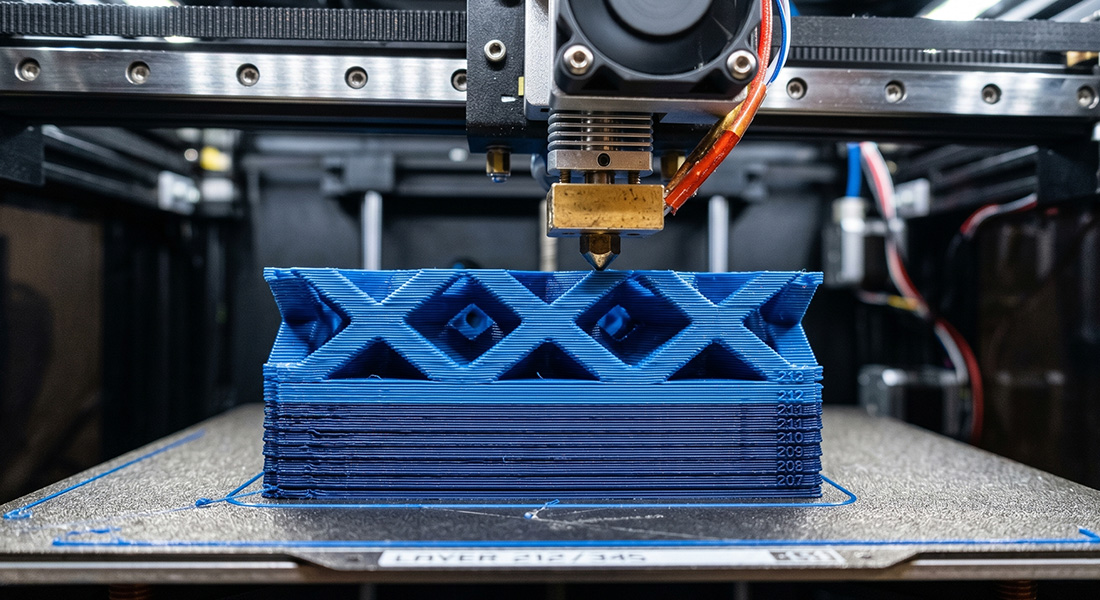
The basic workflow is straightforward: Digital Model → Sliced Layers → Printed Part → Post-Processing.
CAD Modeling & Slicing: The process begins with a precise digital file. This is imported into slicing software, which divides the geometry into hundreds of thin horizontal layers. During this stage, engineers adjust critical parameters such as print orientation, support structures, and infill density to optimize part strength and print time.
Layer-by-Layer Printing: The 3D printer executes the sliced file, adding, curing, or fusing material one layer at a time. This allows for the creation of complex internal channels and lightweight lattice structures that are nearly impossible to machine traditionally.
Post-Processing: Straight off the printer, most parts require finishing. This can range from simple support removal and UV curing to more advanced media blasting, painting, or even CNC post-machining on critical mating surfaces to achieve tight tolerances.
For OEM engineers, it is useful to compare 3D printing with CNC machining because both methods are commonly used for custom parts.
| Factor | 3D Printing (Additive) | CNC Machining (Subtractive) |
|---|---|---|
| Process Type | Adds material layer by layer | Removes material from solid stock |
| Best For | Prototypes, complex shapes, low-volume parts | Precision parts, strong metal components, repeatable production |
| Tooling Requirement | Usually low tooling requirement | Usually no mold required, but machining setup is needed |
| Material Waste | Often lower for complex geometries | Can be higher when removing large amounts of material |
| Surface Finish | Often requires post-processing | Usually provides better machined surface finish |
| Tolerance Control | Depends on process and material | Often preferred for tighter tolerance requirements |
| Materials | Plastics, resins, powders, metals, composites | Metals, plastics, engineering materials |
| Typical Use | Design testing, fixtures, samples | Functional parts, final components, batch production |
3D printing is often useful during the design and testing stage. CNC machining is often preferred when the part requires tight tolerances, machined surfaces, threaded features, strong metal properties, or repeatable production quality.
In many projects, the two methods work together. A 3D printed prototype can help confirm the shape and fit of a part, while CNC machining can be used later to produce the final metal version.
Different project requirements call for different 3D printing technologies and materials. The most common industrial methods include:
FDM (Fused Deposition Modeling): Works by extruding melted thermoplastic filaments. It is the go-to method for cost-effective concept models and basic fixtures. Common materials include standard plastics like PLA, ABS, and PETG, as well as stronger engineering materials like Nylon, Polycarbonate, and Carbon-fiber composites.
SLA (Stereolithography): Uses a UV laser to cure liquid resins. SLA is ideal when a part requires fine details, smooth surface finishes, or transparency. Materials range from standard and clear resins to specialized tough, flexible, or castable resins.
SLS (Selective Laser Sintering): Fuses polymer powders (usually Nylon 11, Nylon 12, or Glass-filled Nylon) with a laser. Because the surrounding powder supports the part, SLS doesn't need support structures. It’s perfect for durable, functional prototypes and snap-fit assemblies.
Metal 3D Printing (DMLS/SLM): Fuses Stainless steel, Aluminum, Titanium, or Inconel powders. While highly capable of creating lightweight aerospace structures or complex internal cooling channels, it is expensive and usually requires secondary CNC machining to finish threads or bearing seats.
For modern manufacturing teams, 3D printing provides speed and flexibility across several stages of product development:
Rapid Prototyping & Design Validation: Engineers can quickly print physical samples to test form, fit, and function. Checking if a bracket aligns with housing screw holes before investing in a steel mold saves significant time and money.
Manufacturing Aids (Jigs & Fixtures): 3D printing is an excellent tool for shop-floor efficiency. Factories frequently print custom assembly fixtures, positioning tools, Go/No-Go gauges, and CNC soft jaws on demand.
Low-Volume Production & Visual Models: For early market testing or trade show presentations, high-detail printing methods (like SLA) can produce visually stunning, low-volume batches without any upfront tooling costs.
The Advantages: 3D printing allows for faster design iterations, enabling engineers to test multiple versions of a part in days rather than weeks. It eliminates upfront tooling costs for small batches and effortlessly handles highly complex, organic geometries that traditional cutting tools cannot reach.
The Limitations: However, 3D printing has strict boundaries. Printed parts often have visible layer lines requiring manual post-processing. Dimensional accuracy is generally lower than CNC machining, and material strength can be inconsistent (especially along the Z-axis). Furthermore, while cost-effective for 10 prototypes, it is rarely economical for high-volume production.
In modern manufacturing, 3D printing and CNC machining are not competitors—they are partners.
A standard OEM workflow often uses 3D printing to create an early prototype of a shaft support or custom housing. Once the design is proven, the final product is produced via precision CNC machining in aluminum or stainless steel.
Alternatively, a hybrid approach is used for complex components: the base geometry is 3D printed in metal or high-grade plastic, and then Feigeer Tech’s CNC machines are used to mill the critical threaded holes, seal faces, and mating features to exact tolerances.
Is 3D printing the same as additive manufacturing?
Yes. 3D printing is widely referred to as additive manufacturing because it builds parts by adding material layer by layer, rather than removing it.
Is 3D printing better than CNC machining?
Not always. 3D printing excels at rapid prototypes and complex shapes, while CNC machining is superior for tight tolerances, high structural strength, smooth surfaces, and repeatable production.
Can 3D printing be used for final products?
Yes, depending on the material and application. SLS nylon or metal prints are often used for end-use parts, provided the production volume is relatively low and tolerances are manageable.
Does 3D printing require post-processing?
Almost always. Most printed parts require support removal, cleaning, or curing. Functional parts often need sanding, media blasting, or CNC machining on critical features.
3D printing helps engineers shorten development cycles, test ideas practically, and create custom manufacturing aids without heavy tooling investments. However, surface finish, structural strength, and production volume must always dictate the final process selection.
If you are developing a custom part and aren't sure whether 3D printing, CNC machining, or a hybrid approach is best, evaluating your design with a manufacturing partner is the safest route.
Need help choosing the right process for your custom part? Send your 2D drawings, 3D CAD files (.STEP or .STL), material requirements, and target quantities to Feigeer Tech. Our engineering team will help you evaluate the most cost-effective manufacturing approach for your project.


