English


Views: 0 Author: Site Editor Publish Time: 2026-04-22 Origin: Site
In custom shaft manufacturing, surface roughness (Ra) is critical for ensuring both fit and longevity of assemblies. At Feigeer Tech, our precision CNC machining expertise ensures every shaft meets functional requirements with minimal production risk.
From high-RPM micro motor shafts to precision pump shafts, the cutting marks left by CNC tools directly impact friction, vibration, heat, and seal lifespan. For OEM engineers and sourcing managers, understanding the correct Ra value and appropriate shaft heat treatment is essential to balance performance, tolerances, and cost.
This 2026 guide covers standard Ra values, typical applications, practical DFM tips, and how our CNC machining service supports high-quality production.
Surface roughness measures microscopic irregularities on a machined surface.
Parameter: Ra (Roughness Average) – arithmetic mean of absolute deviations
Units: μm or μin
Note: Ra refers to the raw texture from machining or grinding, not post-processing like anodizing.
At Feigeer Tech, we integrate precision CNC machining with controlled surface roughness to optimize your shaft heat treatment results.
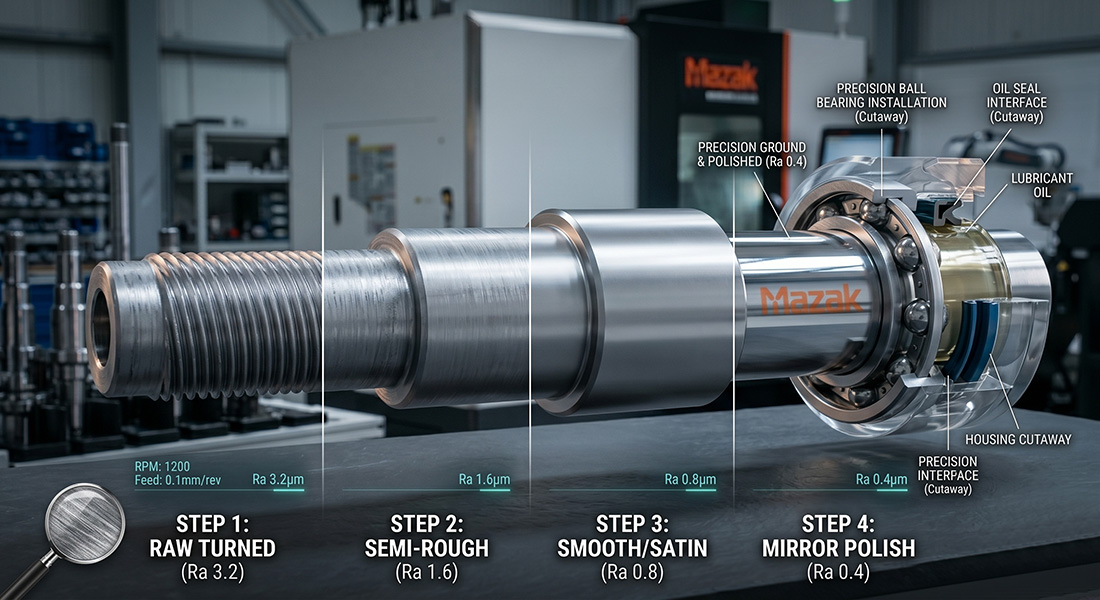
| Ra (μm) | Surface Type | Typical Applications | Cost Impact | Notes |
|---|---|---|---|---|
| 3.2 | Standard Machined | Non-contact parts, clearance zones | Low | Default finish for volume production |
| 1.6 | Close Fit | Press-fit pins, base for knurled shafts | Medium | Smooth with faint cutting marks |
| 0.8 | High Precision | Bearing seats, medium-speed gear hubs | High | Requires careful precision CNC machining |
| 0.4 & below | Ultra-Fine / Mirror | Micro brushless motors, dynamic seals | Highest | Secondary operations; critical functional surfaces |
Tip: Apply stricter Ra requirements only to functional zones to reduce unnecessary machining costs. Our custom CNC machining services allow localized high-precision finishes efficiently.
Avoid unnecessary machining costs by:
Functional Zoning: Apply stricter Ra values only to critical surfaces
Optimized CNC Workflow: Leverage Feigeer Tech’s CNC machining service to perform high-precision cuts in a single setup
Material Selection: Surface roughness depends on tool geometry and machine rigidity, not just steel grade
Tip: For shafts requiring Ra 0.8 or better, perform final precision grinding after heat treatment to maintain specifications.
Feigeer Tech specializes in custom CNC machining services and precision CNC machining for volume OEM orders:
Ultra-thin and micro shafts, including needle shafts and motor shafts
Swiss-type CNC lathes and precision grinding equipment
Tight concentricity and consistent surface roughness
Support for B2B sourcing, OEM projects, and high-volume production
✅ [Submit Your CAD Drawings or Project Details Today for a Free DFM Review]
Q1: Can heat treatment change the surface roughness?
A: Yes, heat treatment can cause slight oxidation or scale. For Ra 0.8+, final grinding after heat treatment is recommended.
Q2: Is Ra the only roughness parameter to monitor?
A: No. High-pressure seals may require monitoring Rz (peak-to-valley height) to avoid single deep scratches affecting performance.
Q3: Does stainless steel always achieve better Ra than carbon steel?
A: Not necessarily. Machining parameters, tool geometry, and CNC rigidity matter more than the steel grade.
Specifying the correct Ra value ensures reliable mechanical assembly and cost-effective production. Whether sourcing high-volume micro shafts or precision-ground locating pins, Feigeer Tech provides expert guidance to balance performance, tolerances, and costs.
[Submit Your Project Details or CAD Files for a Competitive CNC Machining Quote]


