
Views: 0 Author: Site Editor Publish Time: 2026-05-08 Origin: Site
As manufacturing evolves, OEM companies are no longer choosing between 3D printing and CNC machining—they are combining them. Today's 3D printing services excel at rapid prototyping, allowing engineers to quickly source custom 3D printed parts for complex geometries. Meanwhile, precision CNC machining remains the absolute go-to for tight tolerances and production-grade strength.
At Feigeer Tech, we believe these technologies work best together. We blend traditional machining expertise with advanced manufacturing capabilities, helping you select the perfect process based on your performance, lead time, and production goals.
3D printing (additive manufacturing) builds parts layer by layer directly from a digital CAD model. Unlike subtractive methods that cut material away, 3D printing only deposits material where needed.
This approach offers faster prototyping, less material waste, and cost-effective low-volume customization—drastically shortening development cycles. Widely used in automotive, medical, and aerospace industries, the two most common industrial methods are SLA (Stereolithography) and FDM (Fused Deposition Modeling).
CNC machining is a precision subtractive process that uses computer-controlled cutting tools to remove material from solid metal or plastic blocks.
Compared to additive manufacturing, CNC is renowned for its high dimensional accuracy, tight tolerances, and superior material strength. It is essential for industrial components requiring structural durability. Common operations include CNC turning, milling, and grinding. At Feigeer Tech, our Custom CNC Machining Services support diverse OEM projects, from precision shafts to complex assemblies.
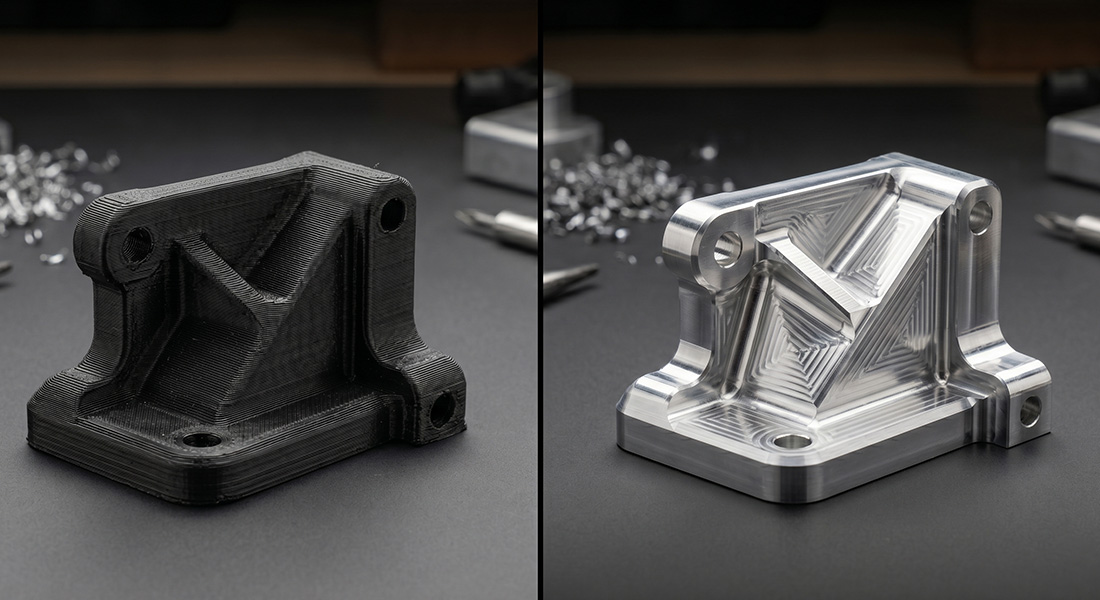
While both technologies create parts from CAD data, their ideal applications differ significantly:
| Feature | 3D Printing | CNC Machining |
|---|---|---|
| Manufacturing Method | Additive | Subtractive |
| Best For | Prototypes & complex geometry | Precision production parts |
| Surface Finish | Moderate | Excellent |
| Material Strength | Depends on process/material | High |
| Tolerance Accuracy | Moderate | Very high |
| Production Volume | Low to medium | Medium to high |
| Speed for Prototypes | Very fast | Moderate |
Speed is the ultimate advantage. Engineers rely on a reliable custom 3D printing service to quickly validate designs before investing in tooling.
Rapid Prototyping: Create functional prototypes in hours instead of weeks, accelerating product launches and engineering reviews.
Complex Geometries: Easily achieve internal channels, lightweight lattice structures, and organic shapes that are impossible or too costly for CNC.
Low-Volume Customization: Cost-effectively produce custom fixtures, jigs, and short-run plastic components without expensive molds.
For end-use industrial applications, CNC machining remains irreplaceable.
Tight Tolerances: Delivers superior dimensional consistency and accurate thread machining for gears, shafts, and reliable assembly fits.
Better Surface Finish: Produces smoother surfaces, perfect sealing interfaces, and premium cosmetic appearances right off the machine.
Production-Grade Materials: Provides access to engineering metals (Aluminum, Stainless Steel, Titanium, Brass) and durable plastics (POM, ABS, Nylon) for maximum heat resistance and strength.
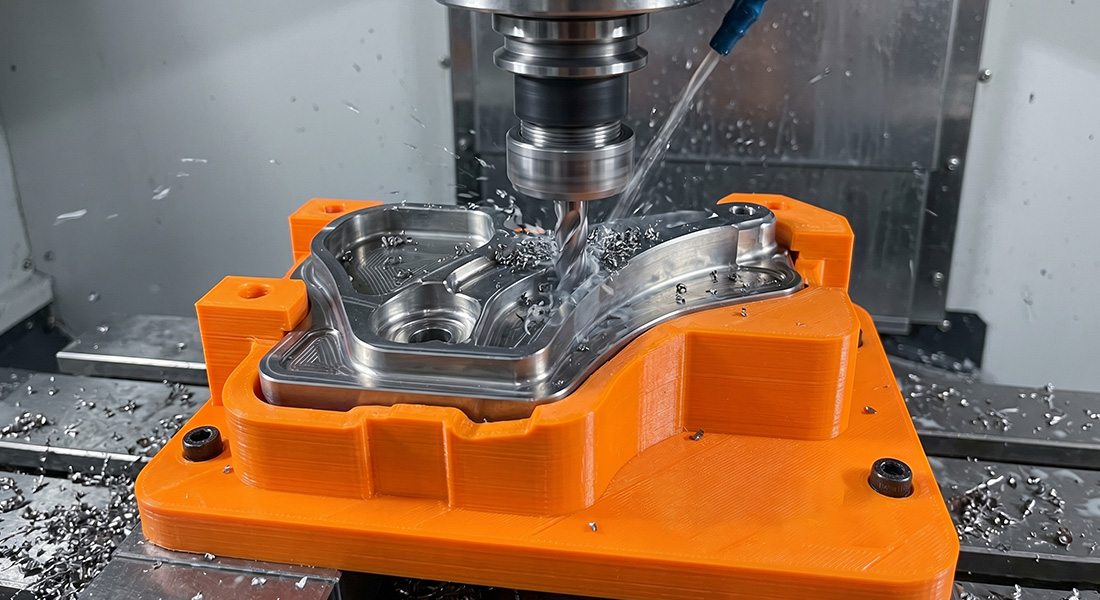
Instead of viewing them as competitors, modern OEMs use both processes for maximum efficiency. A common workflow includes:
3D printing a rapid prototype.
Testing fit and functionality.
Optimizing the design.
CNC machining the final production component.
This strategy yields faster development and lower costs. In some cases, a 3D-printed part may even undergo CNC machining afterward for precision finishing on critical mating surfaces.
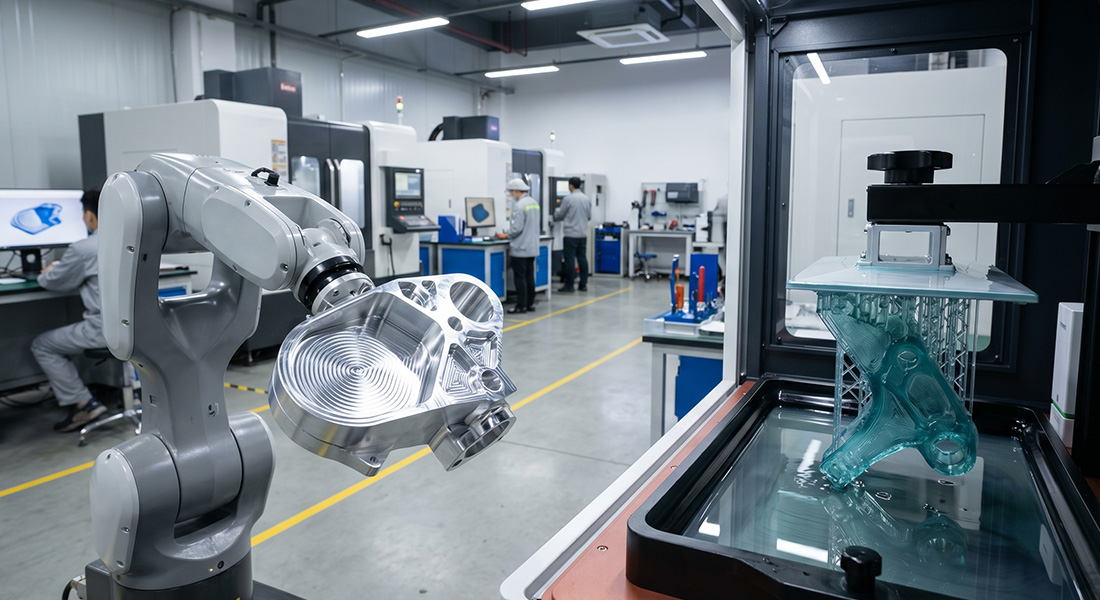
SLA 3D Printing: Uses UV-cured liquid resin. Best for extremely smooth finishes, high detail accuracy, and visual prototypes (like medical models or clear parts).
FDM 3D Printing: Extrudes melted thermoplastic filament. Ideal for lower material costs, durable engineering prototypes, and larger functional test parts.
Unlike basic automated online platforms, our engineering team provides hands-on support. We help you evaluate geometry, tolerances, materials, and cost optimization.
Our comprehensive capabilities include custom CNC machining, engineering DFM reviews, small-batch production, and future SLA/FDM solutions. Whether your project requires rapid prototyping or precision machining, we are ready to help.
Is 3D printing more accurate than CNC machining?
No. CNC machining generally provides tighter tolerances and higher dimensional accuracy.
Can 3D printed parts be CNC machined?
Yes. Many manufacturers use CNC machining to finish critical surfaces on 3D-printed components.
What is the difference between SLA and FDM?
SLA offers smoother surfaces and fine details, while FDM is more durable and cost-effective for larger functional parts.
Which process is better for OEM projects?
The best choice depends entirely on your material requirements, tolerance expectations, and production volume.
Modern manufacturing is no longer about choosing between 3D printing and CNC machining. 3D printing accelerates prototyping and enables complex geometries, while CNC machining delivers the precision and strength required for production. By leveraging both, manufacturers can optimize workflows and achieve better engineering results.
Looking for a reliable manufacturing partner?
➡ [Contact Feigeer Tech today] to discuss your custom CNC machining, prototype development, or whether you need a dedicated print service, 3D additive solutions, or future manufacturing requirements.


