
Views: 0 Author: Site Editor Publish Time: 2026-04-29 Origin: Site
In precision CNC machining, threaded shafts are critical components used in fastening, motion control, and power transmission systems.
For OEM engineers, designing a custom threaded shaft is not just about adding threads—it involves selecting the correct thread profile, ensuring pitch accuracy, and matching the right assembly components.
At Feigeer Tech, our Custom CNC Machining Services focus on delivering high-precision threaded shafts that minimize wear, eliminate backlash, and improve overall mechanical performance.
Selecting the correct thread type is essential for performance and durability in threaded shaft machining.
Metric & Unified Threads (M, UNC, UNF)Widely used for fastening applications across global industries.
Acme & Trapezoidal ThreadsDesigned for high load capacity and power transmission, ideal for lead screws and drive systems.
In automation, robotics, and medical devices, the stepper motor threaded shaft converts rotary motion into precise linear movement.
To prevent backlash and ensure smooth operation, thread pitch must be controlled with extreme precision.
Our precision CNC machining ensures consistent pitch accuracy across the entire shaft, enabling stable actuator performance in high-precision applications.
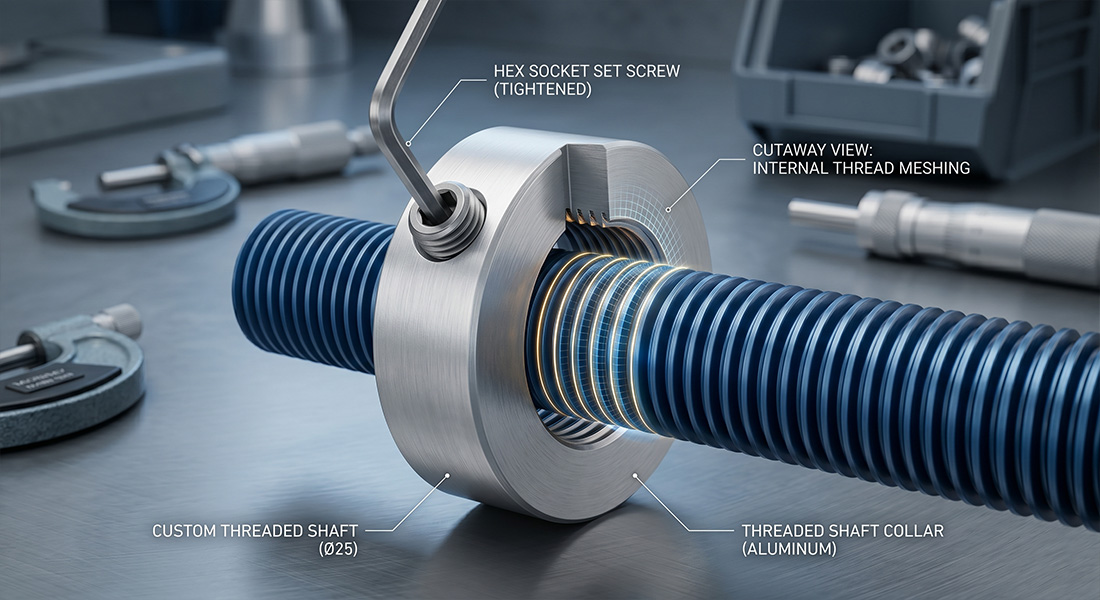
A high-quality threaded shaft requires an equally reliable locking mechanism.
Traditional shaft collars with set screws may slip or damage the shaft surface under high loads. In contrast, a threaded shaft collar provides a more secure and durable solution.
Direct engagement with shaft threads
Higher axial load capacity
No surface damage
Improved vibration resistance
At Feigeer Tech, we manufacture both custom threaded shafts and matching threaded shaft collars to ensure perfect fit and long-term reliability.
Optimizing your design can significantly reduce machining costs and lead time when working with a CNC machining service.
Relief grooves allow cutting tools to exit cleanly, improving thread quality and preventing tool wear.
Threads can deform during shaft heat treatment. For best results:
Perform heat treatment first
Follow with precision thread grinding
This ensures high accuracy and surface integrity.
Threads deeper than 2.5× diameter provide minimal benefit but significantly increase machining time and cost.
When designing a custom threaded shaft, consider:
Load requirements (axial vs rotational)
Required precision (backlash sensitivity)
Operating environment (wear, temperature, vibration)
Material selection and heat treatment
Working with an experienced CNC threaded shaft manufacturer helps ensure optimal design and production efficiency.
Q1: What is the best thread type for a threaded shaft?
A: It depends on the application. Metric/UN threads are best for fastening, while Acme or trapezoidal threads are ideal for motion and load transmission.
Q2: How do you prevent backlash in threaded shafts?
A: By maintaining precise thread pitch and using high-precision CNC machining or post-machining grinding.
Q3: Can threaded shafts be heat treated?
A: Yes, but post-treatment machining is often required to maintain accuracy.
Q4: What materials are commonly used for threaded shafts?
A: Carbon steel, alloy steel, and stainless steel depending on strength and corrosion requirements.
A well-designed threaded shaft is critical for reliable mechanical performance. By combining proper thread selection, precise CNC machining, and controlled heat treatment, OEM engineers can significantly improve product durability and efficiency.
Ready to start your custom threaded shaft project?
➡ Contact Feigeer Tech today for expert DFM support and a competitive quote on your Custom CNC Machining Services.


